Quick answer: In Las Vegas, the venue's AV provider usually runs the house sound, and that's often Encore. Your videographer gets clean session audio by asking that team for a line-level feed from the mixer. Some venues charge an "audio patch fee" for it. Settle who runs the mixer, what the feed costs, and which rooms are covered 2–3 weeks before the show, and always record backup audio on your own mics.
Great conference video lives or dies on audio. Viewers will forgive a soft shot. They won't sit through a keynote that sounds like it was recorded from the back of the ballroom. In Vegas there's an extra layer: the people who run the microphones usually aren't your video crew. They're the venue's AV team. Here's how that works, venue by venue, and what to ask before load-in.
Who actually runs the AV at Las Vegas venues?
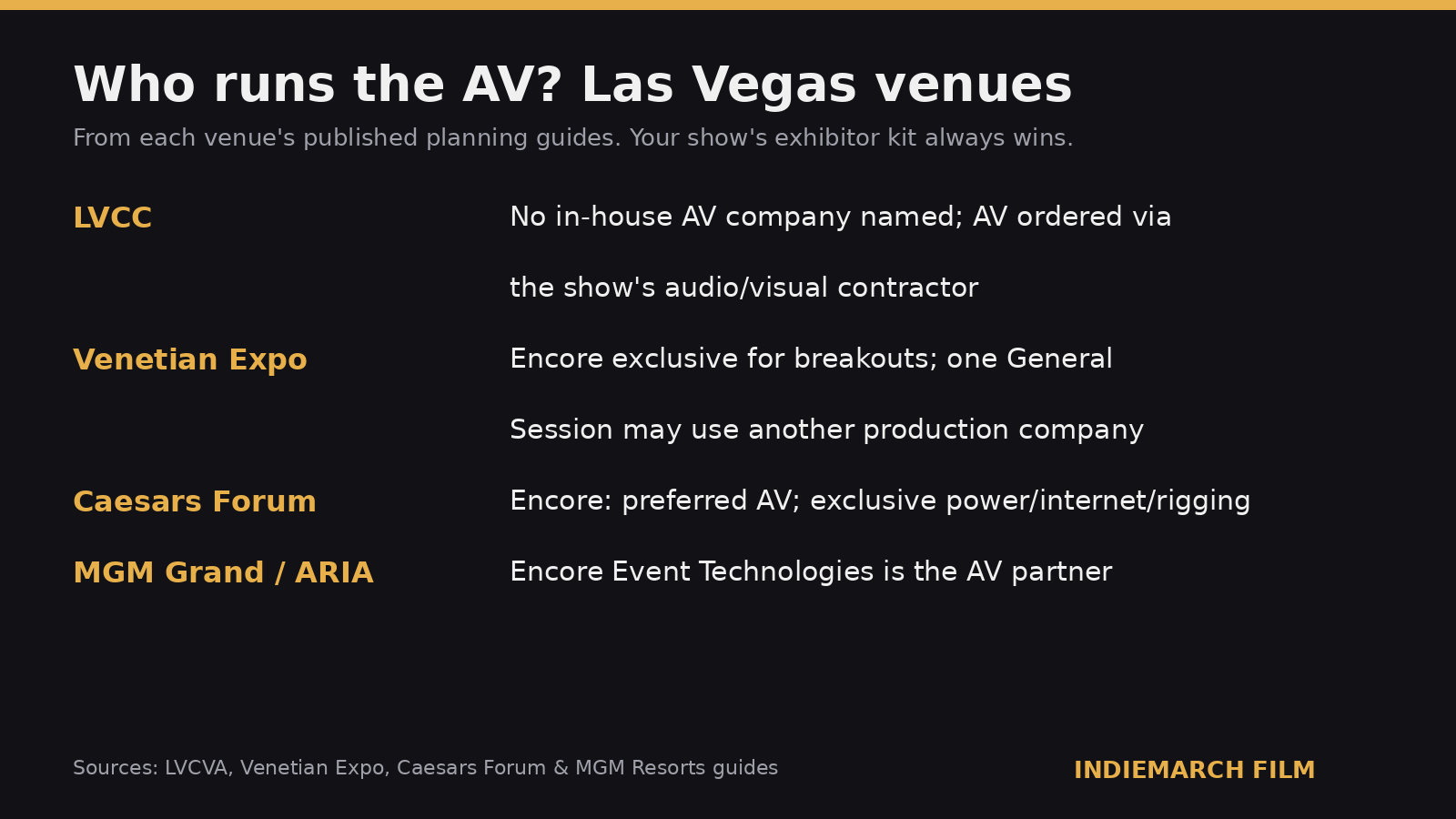
Every property sets its own rules, and your show's exhibitor kit overrides all of them. Here's what the venues publish:
Las Vegas Convention Center (LVCC): The LVCVA's resource guide doesn't name one house AV company. Projectors, screens, and wireless mics are "to be ordered through the audio/visual contractor" for your show. Meeting rooms in the North, Central, and South halls have six-channel mixers patched to the overhead speakers. West Hall rooms use Crestron wall panels with up to four audio lines, and above four inputs the AV contractor must provide an operator.
Venetian Expo: Encore runs AV for breakout rooms exclusively. Each event gets one General Session that another production company can produce. Exhibitors can bring their own AV inside their booths.
Caesars Forum: Encore Event Technologies is the preferred provider for audiovisual, and the exclusive provider for internet, electrical, rigging, and labor (per the RE+ 2025 exhibit rules).
MGM Resorts properties (MGM Grand, ARIA, and others): MGM names Encore Event Technologies as its AV partner, with sales and operations teams on site.
What this means for you: at most Strip resorts, your videographer is a guest in Encore's room. At the LVCC, the AV contractor is whoever your show hired. For example, RE+ 26 (Nov 17–19, 2026, at the LVCC) listed Shepard AV for audio visual.
What is an audio patch fee?
When an outside crew plugs into the house sound system, the venue's AV provider may charge for the connection. Published examples from Encore-served Vegas properties:
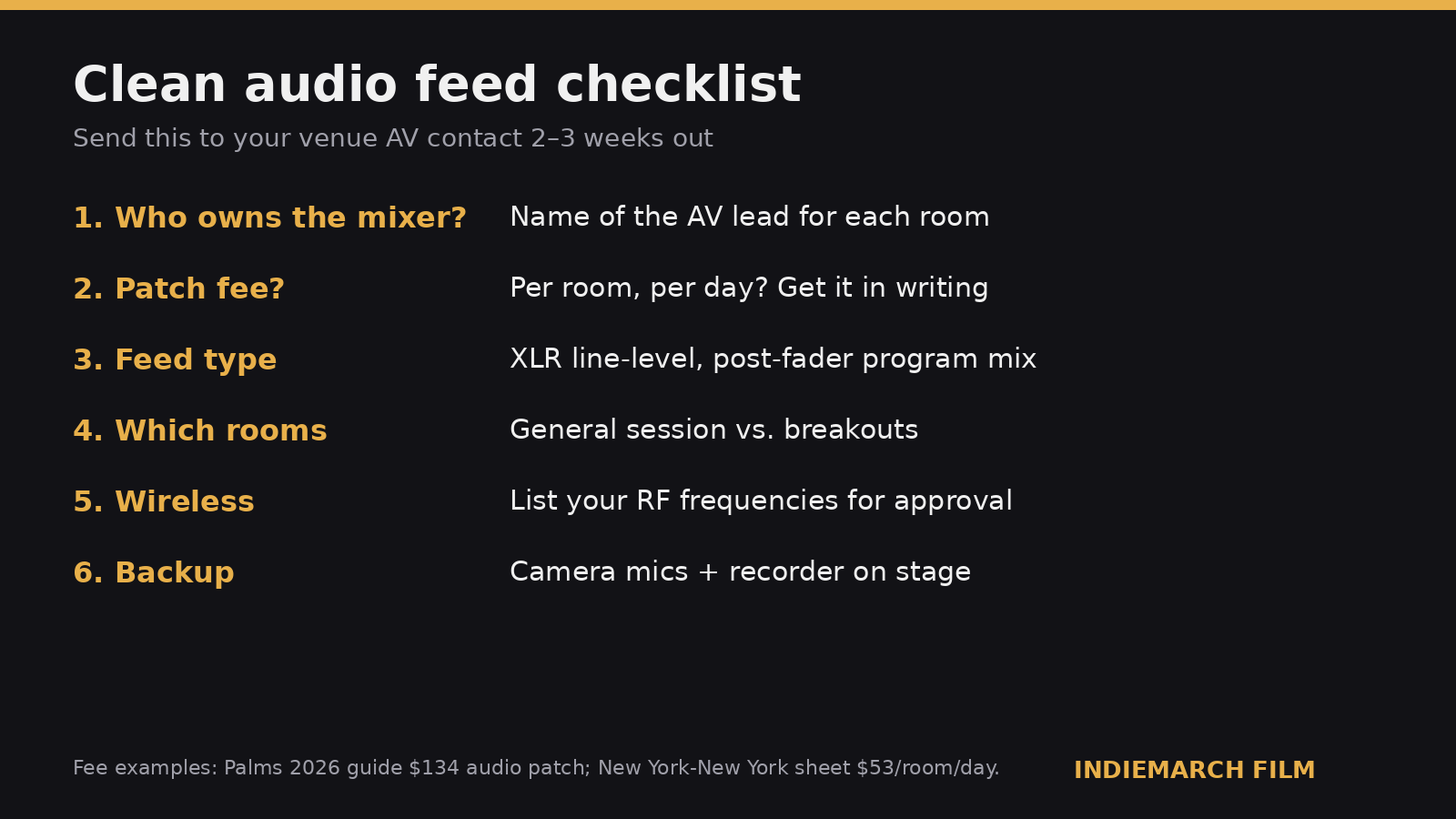
Palms (2026 Encore price guide): Audio patch fee, $134.00. Equipment in that guide is also subject to a 23% service charge.
New York-New York (meetings price sheet): $53.00 per room, per day, to patch into the house sound, billed to the production company, AV company, or meeting group that needs it.
Those numbers vary by property and change over time. Ask your venue for the current rate in writing, and ask whether it applies per room, per day, or once. If you're booking a block of breakouts, that adds up fast, so decide which sessions really need to be recorded.
The clean feed: what to ask for
Your videographer should send the venue AV lead a short, specific request. Ours usually covers:
The feed itself. A line-level XLR output from the room's mixer, carrying the program mix (all the stage mics and playback), ideally post-fader so it follows the A1's levels.
Which rooms and which sessions. General session vs. breakouts. At the Venetian Expo, that distinction also decides who's allowed to run the AV at all.
Who to talk to on site. A name and cell number for the audio tech in each room you're recording.
Wireless coordination. If your crew uses wireless lavs or camera links, expect to share your frequencies. Encore-run venues' outside-vendor guidelines can require a list of every frequency you'll use, and Encore may need to approve them.
Playback and video. If the keynote includes video rolls, ask whether that audio comes through the same feed, so your edit doesn't have dead air.
Billing. Who pays the patch fee: the client, the production company, or the meeting group? Get it on the AV quote, not on a surprise invoice.
Always record backup audio
A house feed is great until someone mutes the wrong channel. A solid conference crew records at least two sources:
The house feed into the camera or an external recorder.
A separate recorder or mic near the stage or on the lectern, for room tone and as a safety track.
Camera audio on every angle, for syncing multicam in the edit.
At the LVCC, remember the house mixers are basic and inventory-limited. If your session has more than four mic inputs in a West Hall room, the venue guide says the AV contractor provides an operator. Find out who that person is before the session starts.
Exhibitor booths are a different situation
Shooting inside your own booth? You're usually not tapping house sound at all. The Venetian Expo allows exhibitors to provide their own AV equipment, and many shows let exhibitors hire an outside crew as an Exhibitor Appointed Contractor (EAC). At the LVCC, every contractor working in the building needs an annual LVCVA EAC permit ($250/year plus insurance). Check your show's EAC deadlines; RE+ 26, for example, required a Notice of Intent to Hire an EAC by October 12, 2026. For the full booth plan, see our trade-show booth video checklist.
A simple timeline
4–6 weeks out: Confirm your venue and the show's official AV contractor. Book your video crew. (How far ahead to book)
2–3 weeks out: Send the clean-feed request. Get the patch fee in writing. Submit EAC paperwork if needed.
Load-in day: Videographer meets the A1 in each room, tests the feed, and labels the inputs.
Show day: Monitor both the feed and the backup recorder with headphones the whole time.
Want this handled?
Venue AV coordination is part of how we run every Las Vegas conference shoot, from the LVCC to Strip ballrooms. If you're planning a keynote, breakouts, or a booth shoot, book a discovery call and we'll map out the audio plan with your venue's AV team.